

Choosing a professional display requires more than comparing screen sizes or looking for the highest number on a specification sheet. Panel technology, resolution, and refresh rate each influence different aspects of the viewing experience, but their real value comes from how they work together. For businesses sourcing displays, understanding these relationships can make product selection more closely aligned with workplace, design, and commercial requirements.
Panel Technology Establishes the Display Foundation
The panel is the core component responsible for producing the visible image. Common technologies include IPS, VA, and TN, with each using a different approach to controlling liquid crystals. Their characteristics can affect viewing angles, contrast, color reproduction, and response behavior.
IPS panels are commonly selected for applications where consistent image presentation and wide viewing angles are important. For professional users who work with graphics, documents, or visual content, these characteristics can be more relevant than simply choosing the largest screen available.
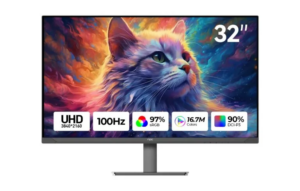
Our NPC-MU3207-K uses a 32-inch TFT-LCD panel with IPS technology. It provides 178° horizontal and 178° vertical viewing angles, allowing content to remain accessible when several people are viewing the screen from different positions.
Resolution Determines Image Detail
Resolution describes the number of pixels used to create an image. More pixels can provide greater detail and more workspace, although the practical benefit depends on screen size, viewing distance, operating-system scaling, and the applications being used.
Ultra HD, commonly referred to as 4K UHD for monitors, uses 3840×2160 pixels. Compared with lower-resolution formats, this provides a substantially denser pixel structure and can support detailed images, complex interfaces, and large working areas.
The NPC-MU3207-K combines its 32-inch screen with a maximum resolution of 3840×2160 and a 16:9 aspect ratio. This combination makes it relevant to professional environments where screen detail and workspace are important considerations.
Refresh Rate Controls Motion Updates
Refresh rate measures how many times a monitor can update its displayed image each second, expressed in hertz. A 60Hz display refreshes the image 60 times per second, while a 100Hz display can refresh it up to 100 times per second.
Higher refresh rates can make scrolling, cursor movement, animation, and other moving content appear smoother. However, refresh rate should be considered alongside the application. Office productivity, design, media production, and gaming can have different priorities, so the highest available refresh rate is not automatically the most appropriate choice.
Our NPC-MU3207-K supports a maximum refresh rate of 100Hz. The specification therefore provides additional motion smoothness while maintaining a configuration suitable for professional desktop applications.
How the Three Specifications Work Together
Panel type, resolution, and refresh rate should not be evaluated independently. A high resolution establishes image detail, the panel determines important image characteristics, and refresh rate affects how smoothly changing images are displayed.
Consider a 32-inch 4K IPS monitor. Its resolution can provide substantial workspace and fine detail, while IPS technology supports wide viewing angles. A 100Hz refresh rate then adds smoother movement compared with a conventional 60Hz configuration.
This relationship is particularly relevant for PC monitor manufacturers because product positioning depends on the complete configuration rather than a single specification. Buyers can better identify suitable models when they connect technical specifications with actual workloads.
Color and HDR Add Another Layer
Resolution does not determine color reproduction. Professionals working with graphics, photography, video, or digital content also need to consider color gamut and related display capabilities. A wider gamut can represent a broader range of colors, provided the content and workflow are designed to use it.
The supplied specification for our NPC-MU3207-K identifies 97% sRGB color gamut coverage and DCI-P3 color gamut support. The model also supports HDR10, providing an additional capability for compatible high-dynamic-range content.
These features broaden the monitor’s relevance beyond basic office computing. For designers and other visual professionals, they can form part of a specification set intended for more demanding content workflows.
Connectivity and Mounting Matter in Deployment
A professional monitor also needs to connect effectively with the computers and equipment used by its target customers. Interface selection can influence compatibility and deployment flexibility, particularly when businesses standardize displays across different workstations.
The NPC-MU3207-K provides one HDMI input and one DisplayPort input. It also supports VESA 100×100 mounting, allowing businesses to consider compatible mounting solutions when configuring desks, workstations, or multi-display environments.
For PC monitor manufacturers, these practical specifications can be as important to commercial buyers as headline image performance. A technically capable display still needs to fit the customer’s existing infrastructure.
Match the Specification to the Application
A useful purchasing process starts with the intended workload. Office users may prioritize resolution, readability, and ergonomic installation. Designers can place greater emphasis on panel characteristics and color gamut. Users handling dynamic content may give greater attention to refresh rate.
For distributors and OEM buyers, this application-based approach can also help create a more balanced product portfolio. Instead of treating one specification as universally superior, buyers can select models according to the requirements of their target markets.
At NPC, we specialize in smart TVs, monitors, and computing products, developing display solutions for different business and professional applications. Our NPC-MU3207-K combines a 32-inch IPS panel, 3840×2160 Ultra HD resolution, 100Hz maximum refresh rate, 97% sRGB color gamut, DCI-P3 support, HDR10, HDMI, DisplayPort, and VESA support.
Build Better Displays Around Real Requirements
Understanding how panel technology, resolution, and refresh rate interact provides a stronger foundation for monitor procurement. Instead of focusing on isolated specifications, businesses can assess how the complete display configuration supports productivity, visual work, content consumption, and deployment requirements.
At NPC, we work with PC monitor manufacturers, distributors, OEM buyers, and other business customers seeking display solutions matched to their markets. Our professional monitor range is designed around practical combinations of display performance and connectivity. Contact NPC today to discuss monitor configurations for your target applications and sourcing requirements.