
Selecting a premium television involves more than choosing a large screen or a high resolution. For business buyers, distributors, hospitality operators, and professional display projects, picture quality depends on how several technologies work together. Mini LED has become an important development because smaller backlight units enable more precise local dimming.
When evaluating the best mini LED TV for a particular application, buyers should examine resolution, backlight technology, dimming zones, brightness, contrast, color performance, viewing angle, refresh rate, and expected service life. Looking at these specifications together provides a more practical basis for comparing display solutions.
Start with Display Technology and Resolution
Display technology determines how a television produces and controls light. QD-MiniLED combines Mini LED backlighting with quantum-dot-based color technology, allowing manufacturers to target both precise light management and broad color reproduction. Mini LED itself uses smaller LEDs than conventional LED backlights, enabling more localized control across the screen.
Resolution should be considered alongside screen size and viewing distance. A 3840×2160 resolution provides the 4K pixel structure widely used in modern premium televisions. For commercial applications where viewers may sit relatively close to a large display, higher resolution can help preserve fine image details and text clarity.
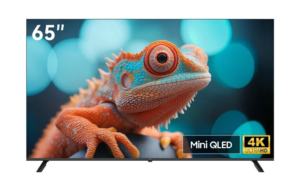
Our NPC-MiniLED 65M1 uses QD-MiniLED display technology and a QD-MiniLED backlight unit. It provides a 3840×2160 resolution, giving businesses a clearly defined specification when assessing a display for entertainment, hospitality, retail, or other professional environments.
Compare Local Dimming Zones Carefully
Local dimming is one of the most important specifications for Mini LED televisions. Backlight zones can be controlled independently, allowing darker portions of an image to receive less backlight while brighter areas remain illuminated. This approach can improve perceived contrast and reduce the washed-out appearance associated with less precise backlighting.
Zone count is therefore worth comparing, particularly between displays of similar size. More zones can provide finer control because each zone covers a smaller portion of the screen. However, zone count should not be viewed in isolation because panel characteristics and the underlying light-control system also affect the final image.
The NPC-MiniLED 65M1 features 198 backlight zones. This specification supports detailed local light management and forms an important part of the display’s overall picture-performance design.
Evaluate Brightness and Contrast Together
Brightness affects how effectively a display presents highlights, particularly with HDR content. Peak brightness and average brightness describe different aspects of performance, so buyers should avoid treating one number as a complete picture of screen quality.
Contrast is equally important because it describes the separation between bright and dark portions of an image. Mini LED’s localized backlight control is specifically intended to strengthen this separation. Manufacturers also identify local dimming and peak brightness as core indicators when evaluating Mini LED picture quality.
For the NPC-MiniLED 65M1, average brightness is specified at >500 cd/m², while peak brightness is >800 cd/m². Its specified contrast ratio is >1000000:1. These figures provide concrete reference points for buyers comparing displays for different lighting and viewing conditions.
Check Color Performance and Viewing Angle
Color reproduction is another important comparison point, especially for premium entertainment and visual-content applications. Color gamut indicates the range of colors a display can reproduce, while the stated color-depth specification provides additional information about how many gradations the system can represent.
The NPC-MiniLED 65M1 specifies a color gamut of >85% NTSC and color reproduction of 1.07B (8bit+FRC). These specifications should be assessed alongside the type of content being displayed and the visual expectations of the target application.
Viewing angle can also affect shared-screen environments. The NPC-MiniLED 65M1 specifies a horizontal and vertical viewing angle of 178°/178° (typ.). This can be relevant for meeting spaces, hospitality environments, retail settings, and living areas where viewers may watch from different positions.
Consider Refresh Rate and Product Longevity
Refresh rate determines how frequently the display refreshes its image and can influence the appearance of moving content. For business buyers, the appropriate refresh rate depends on the intended application rather than simply selecting the largest specification available.
The NPC-MiniLED 65M1 has a 60Hz refresh rate, providing a clearly defined specification for everyday entertainment and general display applications. Buyers can compare this figure with their actual content requirements, particularly when evaluating televisions for sports, gaming, presentations, or digital entertainment.
Expected operating life is another consideration for commercial purchasing decisions. The NPC-MiniLED 65M1 specifies a minimum lifetime of >20,000 hours, giving organizations a useful reference when considering long-term deployment and replacement planning.
Make the Comparison Based on the Complete Specification
There is no single specification that defines the best mini LED TV for every project. A buyer should consider the relationship between resolution, local dimming, brightness, contrast, color performance, viewing angle, refresh rate, and service life. This approach provides a more realistic basis for comparing products than focusing on one headline number.
At NPC, we combine these display technologies into solutions designed for modern viewing requirements. Our NPC-MiniLED 65M1 integrates QD-MiniLED technology, 198 backlight zones, 4K resolution, strong brightness specifications, and a high specified contrast ratio. The television also supports NETFLIX, Prime Video, YouTube, ThinQ AI, HDR compatibility, and Samsung Tizen OS.
For businesses, distributors, and project buyers seeking a best mini LED TV solution based on specific application requirements, we provide detailed product information and display options. Contact NPC today to discuss your project needs and explore suitable Mini LED TV solutions with our team.