

A 100-inch TV is 221.4 cm wide and 124.5 cm tall — screen only, before you add the frame, the stand or the space around it.
Most people searching this are not shopping. They have already decided, or nearly decided, and now they need to know whether the thing will fit: on the wall, through the door, on the existing console. This guide answers that in order — screen size first, then the room, then delivery day, then mounting.
Figures for a specific set come from the NPC XU100TZ900G, a 100-inch 4K QLED. Numbers vary a little between models and brands, so treat them as a realistic reference rather than a universal constant, and check the spec sheet for the exact model you are buying.
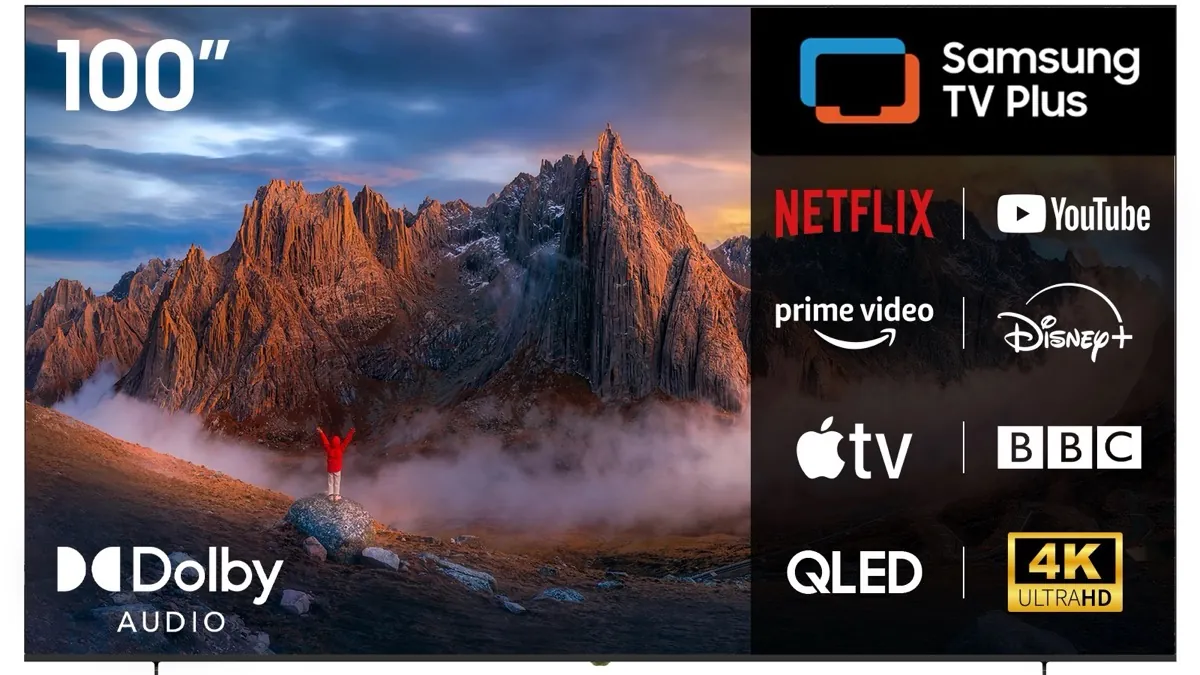
The Actual Measurements
TV sizes are quoted as a diagonal. A 100-inch TV has a 100-inch (254 cm) diagonal, which on a 16:9 panel works out to:
| Measurement | Centimetres | Inches |
|---|---|---|
| Diagonal | 254.0 cm | 100.0 in |
| Screen width | 221.4 cm | 87.2 in |
| Screen height | 124.5 cm | 49.0 in |
| Screen area | 2.76 m² | 4,273 in² |
That is the picture. The physical object is bigger, because the panel sits inside a frame, and bigger again once the stand goes on.
NPC XU100TZ900G, actual chassis dimensions:
| Configuration | Width × Depth × Height |
|---|---|
| Without stand | 2228 × 88 × 1271 mm |
| With stand | 2228 × 390 × 1322 mm |
Three things worth pulling out of that table.
The bezel adds very little width — 2228 mm of chassis around 2214 mm of screen is about 7 mm per side. Modern large-format sets are almost all picture. Do not budget extra wall width for a frame; budget it for the fact that 2.23 m is already a lot of wall.
The stand adds 302 mm of depth, not height. A 100-inch set on its feet needs a console roughly 39 cm deep. Most TV units are 40–45 cm deep, so this usually works, but a narrow floating shelf will not.
The stand only adds 51 mm of height, which surprises people. The panel is so tall that the feet barely change the total.
“100-inch class” is not always 100 inches
Retailers frequently list sets as “100-inch class”. That is a marketing category, not a measurement, and the actual diagonal can be 98 inches or 97.5 inches. A 98-inch panel is 216.9 cm wide against 221.4 cm for a true 100 — about 4.5 cm narrower.
Four and a half centimetres does not matter for picture quality. It matters a great deal if you are building a recess, ordering a fitted cabinet, or working to the millimetre against a chimney breast. When the fit is tight, find the actual diagonal in the specification table rather than trusting the product title.
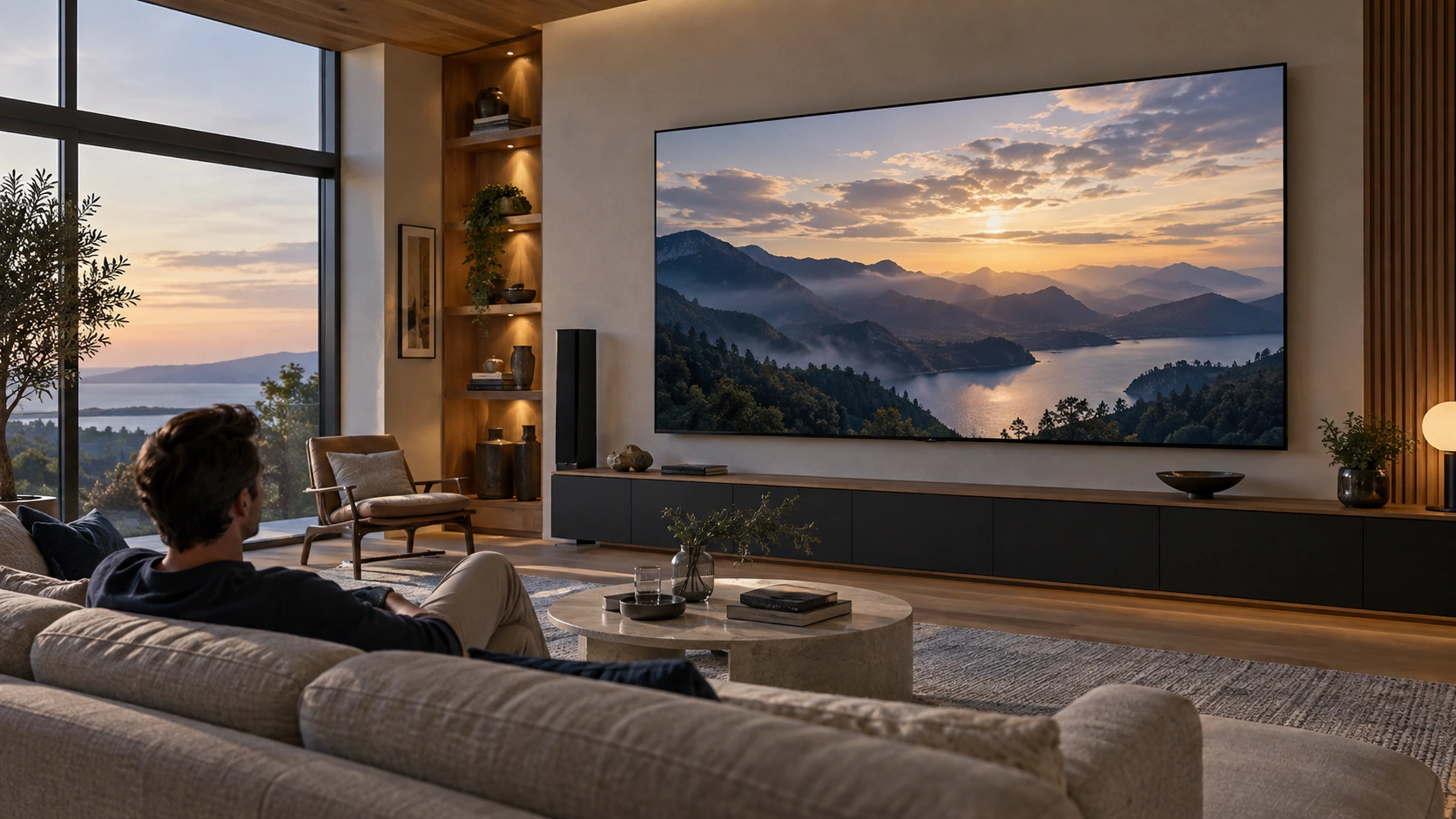
Will It Fit the Wall
Screen size is the easy part. The real constraint is the wall, and then the distance from the wall to where you sit.
Wall width
You need 2.23 m of clear, flat wall for the set itself. In practice, allow more:
Absolute minimum: 2.3 m of uninterrupted wall
Comfortable: 2.6 m or more, so the TV is not wedged between two obstructions
Watch out for: light switches, radiators, door architrave, alcove returns, and picture rails. All of these turn “the wall is wide enough” into “the wall is wide enough except for the bit at the end”
Console width
If the set is going on furniture rather than the wall, choose a console wider than 2228 mm if you want the chassis itself not to overhang. The non-negotiable check is the actual foot spacing and support area: some large sets use feet near the edges, while others use a central pedestal.
Around 240 cm gives useful margin. Check where the feet actually sit before ordering furniture, because the foot layout can matter more than the diagonal size.
Viewing distance
This is where 100 inches most often goes wrong. The picture is not too big; the room is too short.
| Seating distance | Viewing angle | How it feels |
|---|---|---|
| 2.5 m | ~48° | Very immersive, close to front-row cinema. Some people find it too much |
| 3.0 m | ~40.5° | More immersive than THX’s cited 36° cinema-placement reference; comfort is personal |
| 3.4 m | ~36° | Roughly matches THX’s cited horizontal cinema reference angle |
| 4.0 m | ~31° | More relaxed for mixed use — TV on in the background, casual viewing |
| Over 5 m | under 25° | You are no longer getting the benefit of the size |
At 4K resolution you can sit close without seeing pixel structure, so the limiting factor is comfort and field of view, not sharpness. Below roughly 2.5 m most viewers report having to move their eyes across the screen to follow the action, which becomes tiring.
If you want roughly 2.8–3.0 m of seating distance plus a walkway behind the sofa, the room will often need about 3.5 m or more of depth. That is a planning rule, not a universal minimum: NPC’s own product page gives 2.4–3.7 m, while its 85–100-inch category page gives about 3.8–6.2 m for a 98/100-inch set using a 1.5–2.5× diagonal heuristic.
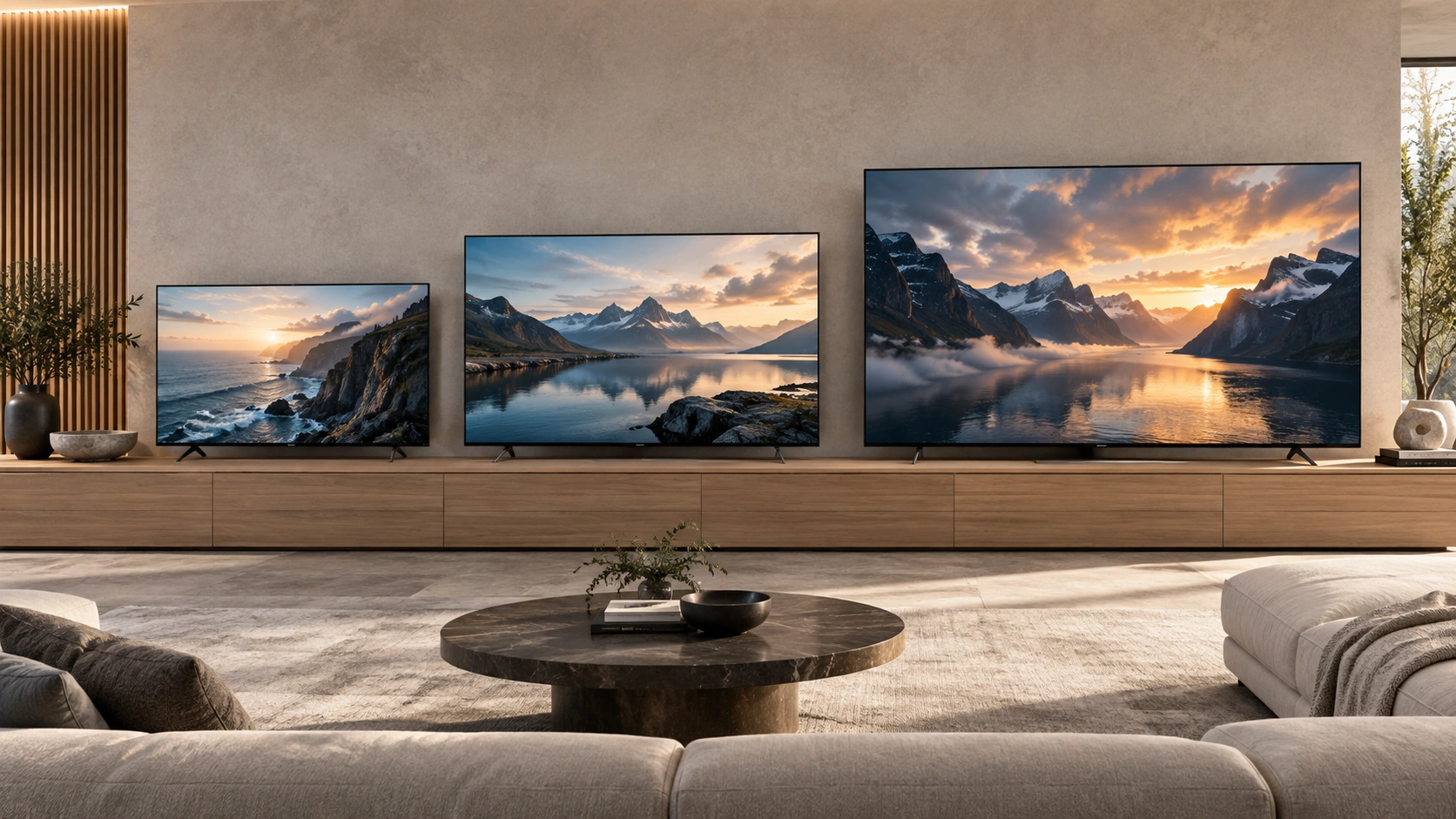
How it compares to 75 and 85 inches
| Size | Screen width | Screen height | Screen area |
|---|---|---|---|
| 75″ | 166.1 cm | 93.4 cm | 1.55 m² |
| 85″ | 188.2 cm | 105.8 cm | 1.99 m² |
| 100″ | 221.4 cm | 124.5 cm | 2.76 m² |
A 100-inch screen is 78% larger in area than a 75-inch and 38% larger than an 85-inch. The jump from 85 to 100 is bigger than most people expect from the numbers — 33 cm of extra width.
Getting It Into the Room
This is the part almost nobody writes about, and the part that most often goes wrong.
The set arrives boxed. A packaged 100-inch TV is longer, deeper and considerably heavier than the TV itself, and the route from the street to the wall has to accommodate the box, not the panel.
What to check before delivery day
Carton length is often the constraint, not door width. A 100-inch carton may be roughly 2.35–2.45 m long as a class-typical planning range. NPC does not publish the packaged dimensions for the XU100TZ900G, so use the supplier’s exact carton specification. A standard interior doorway is often 76–81 cm wide and about 2.03 m tall; the difficult point is usually a corridor that requires a 90° turn, or a stairwell with a half-landing.
Measure the diagonal clearance at every turn on the route, not just the door widths.
Lifts are frequently the failure point. A typical residential lift car is 100–140 cm deep. A 2.4 m carton will often not go in flat and may not go in on the diagonal either. If you are above ground level with no freight lift, plan for the stairs — and check the stairwell turns before the delivery is booked.
Weight needs two people, sometimes three. Large-format sets in this class typically run 55–70 kg unpackaged and 85–100 kg boxed. That is a two-person lift at minimum, and three is safer on stairs. NPC does not publish per-model weight on its product pages, so confirm the figure for your specific model with the supplier before arranging help.
Keep the panel upright unless the model’s handling instructions say otherwise. Large LCD panels are generally transported and stored vertically to reduce flexing risk. Confirm the exact handling instructions with the supplier before anyone picks it up.
Quick pre-delivery checklist
Narrowest point on the route, measured diagonally
Every 90° turn between the entrance and the room
Lift car dimensions, or stairwell turn clearance
Two or three people available on the day
Somewhere to put the box — an empty 100-inch carton takes up a surprising amount of floor
Wall or console prepared before the set arrives, so it does not have to be stored
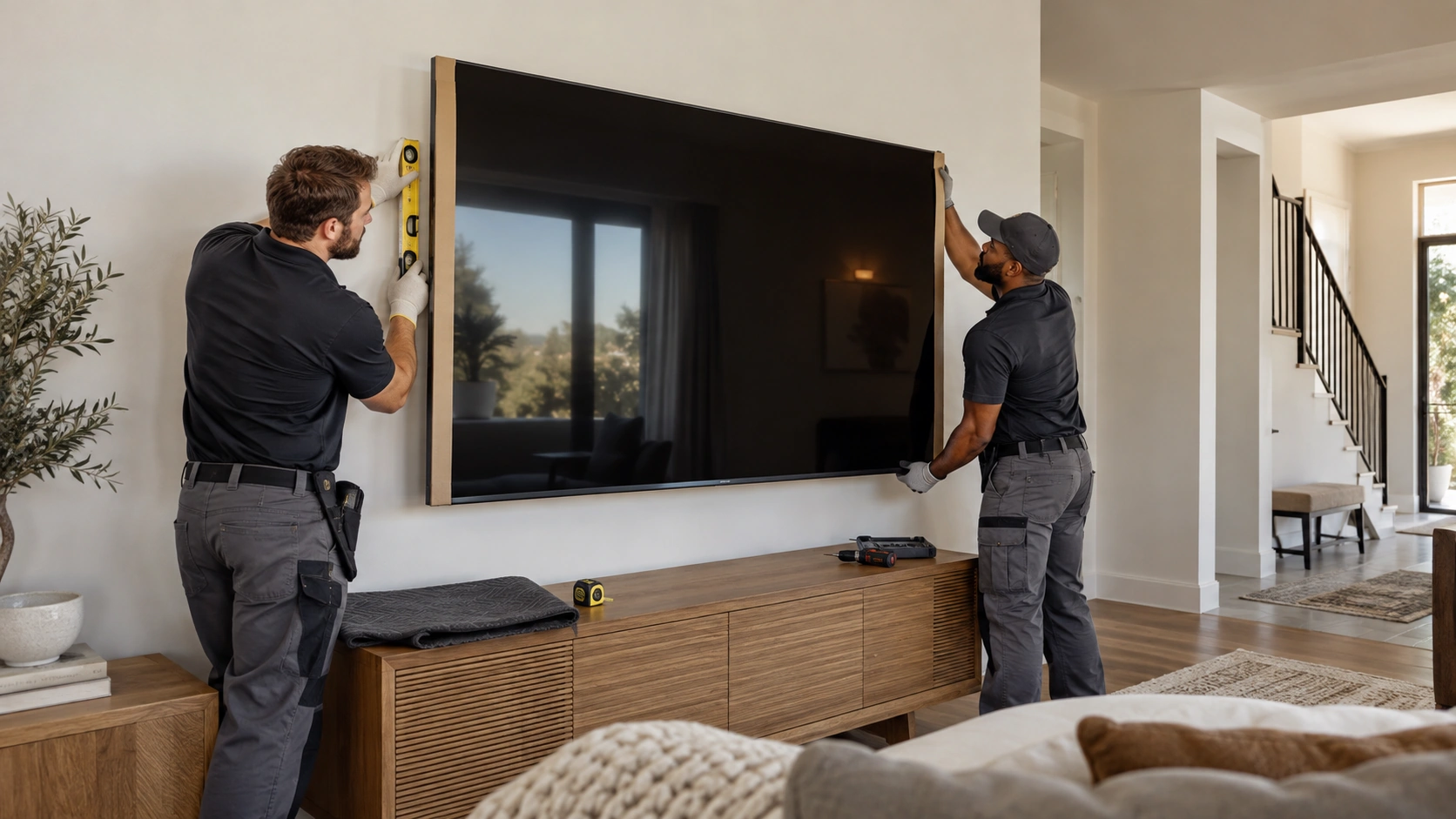
Mounting
Bracket rating
A wall bracket is rated for a maximum weight and a maximum screen size, and both need to clear your set with margin. Choose a bracket rated above the exact TV weight, with the required margin specified by the bracket and TV manufacturers. NPC does not publish the XU100TZ900G’s weight, so a generic 75 kg threshold cannot be confirmed as a safe target.
Do not use a bracket rated exactly at the panel weight. Do not use one rated for “up to 85 inches” on a 100-inch set even if the weight figure works; the arm spacing will be wrong.
VESA pattern
The VESA pattern is the spacing of the four threaded holes on the back of the panel, quoted in millimetres. Large-format sets typically use 600 × 400 or 800 × 400. NPC does not list the VESA pattern in its online specification tables, so confirm it with the supplier or measure the holes directly before buying a bracket — a 200 mm mismatch means the bracket simply does not attach.
Wall construction
This matters more than the bracket for a set this size.
| Wall type | Suitability | Notes |
|---|---|---|
| Solid masonry / concrete | Ideal | Use appropriate expansion or chemical anchors, not plasterboard plugs |
| Brick | Good | Fix into brick, not mortar joints |
| Timber stud + plasterboard | Workable | Must hit at least two studs. Studs are typically 40–60 cm apart; a 100-inch bracket usually spans three |
| Metal stud | Requires care | Standard stud fixings are not adequate at this weight — needs a backing plate or specialist fixings |
| Plasterboard alone | Not suitable as the sole support | Anchor into studs, a properly installed backing plate, or masonry according to the bracket instructions |
If the wall is stud construction and the studs do not line up with the bracket’s fixing points, fit a timber backing plate across at least three studs and mount the bracket to that.
Mount height
The usual rule — centre of the screen at seated eye level — produces a lower mounting position than most people expect on a set this tall.
As a starting point, seated eye level is often around 100–110 cm from the floor. With a 127 cm tall panel, centring on 105 cm puts the bottom edge about 40 cm from the floor. That looks low on paper and correct in the room.
Mounting a 100-inch set at the height you would use for a 55-inch means looking up at it, which causes neck strain over a long film. If the bottom edge has to sit higher — over a fireplace, for example — use a tilting bracket and angle the screen down.
Cables and power
Plan this before the bracket goes on the wall. Once a 100-inch panel is mounted, reaching behind it is genuinely difficult.
Position the socket where it will sit behind the panel, not beside it
Run HDMI before mounting, and run one more than you think you need
Chassis depth without the stand is 88 mm, so a flush bracket leaves very little room for cable bends — use low-profile right-angle connectors
If you are using a soundbar, decide its position now; a 100-inch set leaves less space above the console than you would expect
Which Rooms Suit 100 Inches
Living rooms. Works if you have 3.5 m or more of depth and a 2.6 m wall. In a smaller living room a 100-inch set dominates in a way that stops being enjoyable — you will find yourself sitting at the far edge of the sofa.
Dedicated home cinema. This is the natural home for the size. Controlled lighting, fixed seating at a chosen distance, and no competing furniture. At 3.0 m the horizontal field of view is about 40.5°; at about 3.4 m it is close to THX’s cited 36° cinema-placement reference.
Commercial and hospitality. Lobbies, meeting rooms, showrooms, sports bars. Here the viewing distance is usually generous and the screen has to be readable from across a room, so 100 inches earns its place. Brightness matters more than in a home — check the panel’s cd/m² rating against the ambient light.
When 85 inches is the better choice
Worth saying plainly, because it is often true:
Room depth under 3.2 m. You will sit too close and the size becomes tiring
Wall width under 2.3 m. An 85-inch set needs 1.9 m and gives you breathing room
Upper-floor flat with no freight lift. The delivery problem is real and does not go away
Stud walls you cannot reinforce. An 85-inch panel is meaningfully lighter
Mixed-use room. If the TV is on in the background while people talk and eat, the extra 33 cm buys little
An 85-inch screen has about 28% less area than a 100-inch — a real difference, but a smaller one than the size labels suggest, and it fits a far wider range of rooms.
FAQ
Is a 100-inch TV overkill?
It depends entirely on viewing distance. At 3.0 m it produces roughly a 40.5° horizontal field of view; at about 3.4 m it is close to THX’s cited 36° cinema-placement reference. In a room where you sit 4.5 m away, a 100-inch screen delivers about the same horizontal visual angle as a 65-inch at roughly 2.9 m — the size stops paying for itself as viewing distance grows.
What are the dimensions of a 100-inch TV in centimetres?
The screen is 221.4 cm wide and 124.5 cm tall, with a 254 cm diagonal. The NPC XU100TZ900G chassis measures 222.8 × 8.8 × 127.1 cm without the stand, and 222.8 × 39.0 × 132.2 cm with it.
How much space is needed for a 100-inch TV?
The screen alone is 2.214 m wide; the XU100TZ900G chassis is 2.228 m wide. About 2.3 m is a tight wall minimum and around 2.6 m gives more breathing room. Viewing distance is preference-dependent: NPC gives 2.4–3.7 m for this model, while a THX-like 36° horizontal angle is about 3.4 m for a 100-inch 16:9 screen.
How tall is a 100-inch TV?
The screen is 124.5 cm tall. Including the frame, a typical chassis is around 127 cm, rising to roughly 132 cm on its stand.
How heavy is a 100-inch TV?
Sets in this class generally run 55–70 kg without the stand and 85–100 kg boxed. Weight is not listed on NPC’s online specification tables, so confirm the figure for your model before arranging delivery help or buying a bracket.
How much does a 100-inch TV cost to run?
Power draw depends on brightness setting and content far more than on screen size alone. The XU100TZ900G is rated at ≤500 W maximum and ≤0.5 W in standby — note that the first figure is a maximum rating, not typical viewing consumption, which is substantially lower.
Conclusion
A 100-inch 16:9 TV needs 221.4 cm of visible screen width, while the NPC XU100TZ900G chassis is 222.8 cm wide. Around 2.6 m of wall gives useful margin, and about 3.4 m produces a THX-like 36° horizontal field of view; NPC’s model page gives a broader 2.4–3.7 m guidance range. Everything else — bracket rating, VESA pattern, stairwell turns, mount height — follows from checking the exact model rather than relying on the size label alone.
If your room clears those constraints, the size is genuinely different from an 85. If it does not, an 85-inch set will be the better television in that room, whatever the spec sheet says.
Browse NPC’s 85–100″ range, including the XU100TZ900G, on the Tizen OS TV category page.