
If you are looking at a TV that runs Tizen OS but does not carry the Samsung logo, here is the short answer: it runs the same operating system and the same app platform as Samsung’s own Smart TVs. Netflix, YouTube, Prime Video, and Samsung TV Plus all come through the same Tizen ecosystem, because licensed brands ship the genuine OS, not a lookalike.
That was not always possible. For its first decade, Tizen was exclusive to Samsung hardware, and official licensing has only put it on other brands since 2022[1]. That raises a fair question for buyers: what exactly do you get, and what do you give up? This guide covers the Tizen OS TV apps, features, and differences you should know before choosing a Tizen-licensed TV.
How Tizen OS Ended Up on TVs Beyond Samsung
Tizen reached other TV brands through an official licensing program, not through clones or forks. Samsung announced the Tizen TV Platform Licensing program at its developer conference in 2021, and the first non-Samsung Tizen TVs shipped in October 2022 under brands including Bauhn, Linsar, Sunny, and Vispera, sold across Australia, Italy, New Zealand, Spain, Türkiye, and the United Kingdom[1].
The program has kept widening since. With the launch of Tizen OS 8.0 in 2025, Samsung brought additional original design manufacturers on board and added brands such as EKO, QBELL, RCA, and Axdia across Europe, the Americas, and Australia[2]. The latest wave includes full-lineup adoptions by consumer electronics brands such as NPC and AIWA, both operated by Guangzhou Xianyou, announced in May 2026[3].
The scale explains why licensing matters to app support. Omdia expects Tizen to remain the world’s second-largest TV operating system, holding 17% of global TV shipments in 2025[4]. Developers maintain their Tizen apps because the installed base is enormous, and every licensed TV plugs into that same ecosystem.
Program milestones at a glance:
| Year | Milestone | Brands involved |
|---|---|---|
| 2021 | Licensing program announced at Samsung Developer Conference[1] | — |
| 2022 | First non-Samsung Tizen TVs ship[1] | Bauhn, Linsar, Sunny, Vispera |
| 2025 | Tizen OS 8.0 expansion[2] | EKO, QBELL, RCA, Axdia |
| 2026 | Full-lineup brand adoptions[3] | NPC, AIWA |
What Apps Come With a Tizen-Licensed TV
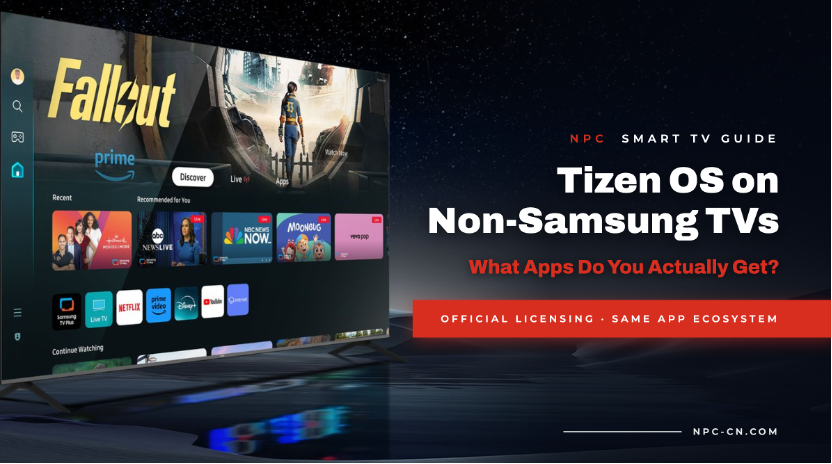
A Tizen-licensed TV gives you access to the same app platform Samsung’s own TVs use. Apps already published for Samsung’s Tizen TVs work on licensed Tizen TVs from other manufacturers as well[5]. In practice, that covers the services most households actually open: Netflix, YouTube, Prime Video, and Disney+ are all established Tizen platform apps.
Licensed TVs also carry Samsung TV Plus, the free ad-supported streaming service. Samsung lists it as a core feature for licensing partners, giving viewers hundreds of live channels, shows, news, and sports at no cost[1]. On top of streaming, Tizen OS 8.0 brings cloud gaming through Samsung Gaming Hub and multi-device connectivity through SmartThings to licensed sets[2].
One honest note: app availability still varies by country, exactly as it does on Samsung’s own TVs. Content licensing is regional, so a niche local streaming service available in one market may be absent in another. That is a property of the streaming industry, not of licensed hardware.
What you can expect on a licensed Tizen TV:
- Major streaming apps: Netflix, YouTube, Prime Video, Disney+, and other established Tizen platform apps[5]
- Samsung TV Plus: free live channels and on-demand content[1]
- Samsung Gaming Hub: cloud gaming without a console[2]
- SmartThings: control of compatible smart-home devices[2]
Licensed Tizen vs. Samsung’s Own TVs: What’s the Same, What’s Different
The operating system is identical, and that is the point of licensing. The Smart Hub interface, the app store, content discovery, and the update pipeline for platform apps all come from the same Tizen codebase. A viewer switching from a Samsung set to a licensed set finds the same home screen logic and the same way of installing apps.
The differences sit in hardware and brand-level decisions, not in the software platform. Each licensed brand chooses its own panel tiers, speaker configurations, and price positioning, so a licensed TV is not a rebadged Samsung flagship. Firmware rollout timing is also managed per brand, and a handful of features tied to Samsung’s flagship hardware, such as Bixby voice control on certain models, may not appear on licensed sets.
| Aspect | Samsung Smart TV | Tizen-licensed TV |
|---|---|---|
| Operating system | Tizen OS | Same Tizen OS |
| App store and platform apps | Tizen app ecosystem | Same ecosystem[5] |
| Samsung TV Plus | Included | Included[1] |
| Panel and hardware tiers | Samsung’s lineup | Set by each brand |
| Firmware update timing | Samsung’s schedule | Managed per brand |
Finding and Installing Apps on a Tizen-Powered TV
Installing apps works the same way across every Tizen TV. From the home screen, open the Apps section, browse or search for the service you want, and select install. Signed-in accounts carry over the way they would on any smart platform: log in once per app and the TV remembers it.
If an app you expect is missing, two checks solve most cases:
NPC’s Tizen OS TV Lineup
NPC adopted Tizen OS across its entire TV lineup in 2026 through official licensing, alongside its sister brand AIWA under the Guangzhou Xianyou group[3]. That means an NPC TV runs the exact same operating system found on Samsung’s own branded sets, from the Smart Hub interface to platform apps such as Netflix, YouTube, Prime Video, and Samsung TV Plus[6].
The range is broad rather than niche. NPC’s Tizen OS smart TVs span sizes from compact bedroom sets up to 100-inch home-theater screens[6], all built around the same verified Tizen platform. For readers curious about the less obvious parts of the software, NPC’s guide to hidden Tizen OS features on NPC TVs is a practical follow-up.
One limitation worth stating plainly: NPC sells through regional distribution partners, so specific models and sizes vary by market. If a particular screen size matters to you, confirm local availability with the distributor before planning a purchase around it.
Conclusion
Buying a Tizen TV without the Samsung badge no longer means settling for a stripped-down platform. Licensed sets run the genuine OS, load the same major apps, and include Samsung TV Plus, with the real differences confined to hardware choices and per-brand update schedules. The one thing worth verifying is that the brand is an official licensee.
NPC’s full-lineup adoption puts it firmly in that category. If you are comparing options, the Tizen OS TV range at NPC is a reasonable place to see how far the licensed ecosystem now stretches.
Explore NPC’s Tizen OS Smart TV Lineup
From compact bedroom sets to 100-inch home-theater screens.
Sources
- Samsung Tizen OS Expands Its Global Presence With New Licensing Partnerships. Samsung Newsroom. 2022. news.samsung.com
- Samsung Expands Tizen OS Licensing Program with New Global Partners and Enhanced Offerings. Samsung Newsroom. 2025. news.samsung.com
- NPC & AIWA TVs Now Powered by Samsung Tizen OS. NPC Electronics. 2026. npc-cn.com
- Omdia: CastOS to Exceed 15 Million Shipments, Set to Dominate North America’s TV OS Market. Omdia (press announcement). 2025. morningstar.com
- Samsung seeks smart TV growth with first Tizen OS licensing deals. TechCrunch. 2022. techcrunch.com
- NPC Tizen OS Smart TVs (category page). NPC Electronics. npc-cn.com