

Modern computer monitors serve far more purposes than displaying basic desktop information. They can support office productivity, creative work, entertainment, gaming, and professional applications, making specification evaluation increasingly important for business buyers. When comparing the top monitor manufacturers, purchasers should look beyond screen size and price to understand how resolution, panel technology, color, brightness, refresh rate, connectivity, and mounting compatibility work together.
Resolution Sets the Foundation for Image Detail
Resolution determines the number of pixels available to display text, graphics, photographs, and video. Higher pixel counts can provide greater detail and more usable workspace, although the practical benefit also depends on screen size, viewing distance, operating-system scaling, and the source content.
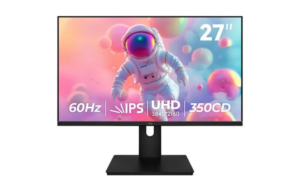
The NPC-MU270A provides 4K UHD resolution at 3840 × 2160 on a 27-inch screen. For business users, this combination can provide detailed visuals while offering additional desktop space for documents, spreadsheets, creative applications, and multiple windows.
Panel Technology Affects Everyday Viewing
Panel technology influences characteristics such as viewing angles, color reproduction, and overall image presentation. IPS panels are widely used in applications where consistent viewing and color performance are important, making the technology relevant to both office and creative environments.
Our NPC-MU270A uses an IPS panel in an ultra-thin monitor design. For distributors and project buyers, this specification can help define the product’s positioning across professional desktop environments where visual quality and a streamlined physical profile are both relevant.
Color Gamut Matters for Visual Applications
Color gamut describes the range of colors a display can reproduce. A wider gamut can be useful for photography, video, graphic design, digital content, and other applications where a broad range of colors is desirable. However, gamut coverage should not be confused with complete color accuracy.
The NPC-MU270A supports DCI-P3, providing a relevant specification for buyers assessing its suitability for content-focused applications. Professional purchasers should also examine calibration information and independent testing when precise color accuracy is a requirement.
For organizations comparing the top monitor manufacturers, evaluating color specifications alongside resolution and panel technology gives a more complete picture of display capability.
Brightness and HDR Should Be Considered Together
Brightness influences how easily content can be viewed under different ambient-light conditions. The appropriate level depends on the working environment, while HDR can expand the range between dark and bright portions of an image.
The NPC-MU270A is specified at up to 350 cd/m² and supports VESA HDR10. These specifications provide useful reference points for buyers evaluating the monitor for general professional use and HDR-compatible content.
It is important to distinguish an HDR format from independently verified HDR performance. VESA notes that its DisplayHDR standard evaluates factors including luminance, color gamut, bit depth, contrast, and other performance characteristics rather than treating HDR as a single specification.
Refresh Rate Should Match the Application
Refresh rate indicates how frequently a display can update its image. Higher refresh rates can contribute to smoother motion, making them particularly relevant to gaming, video playback, and interfaces involving frequent movement.
The NPC-MU270A supports up to 60Hz. This level is appropriate to consider for many conventional business, productivity, and content-viewing scenarios where extremely high refresh rates are not a primary requirement.
Buyers should therefore match refresh-rate requirements to the intended application instead of assuming that a higher figure is automatically necessary. This approach can help business purchasers balance performance requirements against product positioning and cost targets.
Connectivity Determines System Compatibility
A monitor needs appropriate interfaces to communicate with computers and other source devices. DisplayPort and HDMI are widely used digital video interfaces, but the capabilities of a particular connection depend on its specification, supported resolution, refresh rate, and other signal requirements.
The NPC-MU270A provides both DisplayPort and HDMI connectivity. For distributors and integrators, having these interfaces can make the monitor easier to position across different desktop configurations.
VESA describes DisplayPort as a scalable interface designed for high resolutions, fast refresh rates, and deeper color depths. HDMI specifications likewise support combinations of higher resolutions and refresh rates depending on the version and implementation.
Mounting and Physical Design Add Practical Value
Physical design is another consideration that can be overlooked when comparing technical specifications. An ultra-thin structure can help support a cleaner desktop setup, while mounting compatibility can be important for offices, control environments, multi-monitor installations, and other professional applications.
The NPC-MU270A supports VESA mounting, giving professional buyers an additional option when planning different installation configurations. Combined with its ultra-thin design, the feature can be relevant to projects where desk space, installation flexibility, or visual consistency matters.
Building a More Complete Monitor Evaluation
Selecting among the top monitor manufacturers requires a balanced assessment rather than focusing on one headline specification. Resolution establishes image detail, panel technology affects viewing characteristics, and color gamut helps define color capability. Brightness and HDR influence dynamic visual presentation, while refresh rate and connectivity determine how well the monitor fits particular applications and hardware configurations.
At NPC, we are a technology manufacturing enterprise specializing in smart TVs, monitors, and computing products. We provide display solutions that combine practical specifications with different application requirements. Our NPC-MU270A features a 27-inch 4K UHD IPS display, 3840 × 2160 resolution, up to 60Hz refresh rate, 350cd/m² brightness, DCI-P3 support, DisplayPort and HDMI connectivity, VESA mounting, and HDR10 support.
For distributors, retailers, system integrators, and other business purchasers comparing the top monitor manufacturers, reviewing these features together can create a clearer framework for product selection. Contact NPC today to discuss monitor solutions and sourcing requirements for your market.