

Choosing a PC monitor for a business, retail portfolio, or professional workstation requires more than checking screen size and price. Resolution, panel technology, color performance, refresh rate, response time, and connectivity all influence the final user experience. For buyers comparing the best PC monitor manufacturers, understanding how these specifications work together provides a more reliable basis for evaluating products and matching them with different applications.
Start With Resolution and Screen Size
Resolution determines the amount of visual information a monitor can display. A QHD resolution of 2560 × 1440, for example, provides substantially more pixels than Full HD while avoiding the hardware demands associated with some higher-resolution formats.
Screen size should be considered together with resolution. A larger display can provide more working space, but its usefulness depends on pixel density, viewing distance, and the intended application. For business buyers, the combination should suit office productivity, content consumption, gaming, or other target use cases.
Examine the Panel Technology
Panel technology affects viewing angles, color reproduction, contrast, and motion characteristics. IPS panels are widely used where consistent image quality across different viewing positions and strong color performance are important.
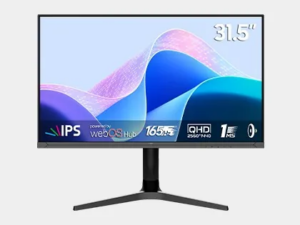
The NPC-MZ3207-Y uses an IPS panel and measures 31.5 inches. It provides QHD resolution at 2560 × 1440, creating a larger workspace for users who need to handle multiple windows while retaining detailed on-screen content. Its ultra-thin design can also support product positioning where desktop appearance is an important consideration.
Evaluate Color Performance Carefully
Color specifications deserve particular attention when a monitor is intended for content creation, digital media, design, or other visually demanding work. A monitor’s stated color gamut indicates the range of colors it can reproduce, although gamut coverage alone does not establish overall color accuracy.
The NPC-MZ3207-Y offers 100% sRGB and DCI-P3 color gamut coverage according to its product specifications. These figures provide useful reference points for buyers assessing the monitor’s suitability for applications where a broad color range is relevant.
For buyers reviewing the best PC monitor manufacturers, it is useful to distinguish between advertised gamut coverage and independently verified accuracy. VESA’s DisplayHDR program, for example, evaluates several characteristics rather than relying on a single display specification.
Look Beyond Refresh Rate
Refresh rate describes how many times per second a monitor can update its image. Higher refresh rates can make movement appear smoother, which is particularly relevant to gaming, fast video, and other applications involving frequent on-screen motion.
The NPC-MZ3207-Y supports a refresh rate of up to 165Hz. This gives it a performance profile suited to users who value fluid motion. However, buyers should confirm how the maximum refresh rate is achieved through the available input interfaces because the source device, cable, resolution, and signal format can affect the achievable combination.
Independent monitor testing commonly checks maximum refresh rates at native resolution through different interfaces and signal configurations.
Check Response Time Alongside Refresh Rate
Refresh rate and response time address different aspects of motion performance. Refresh rate concerns how frequently the display updates, while response time describes how quickly pixels can change between states. A high refresh rate therefore does not automatically mean that motion will be free from visible blur or trailing.
Our NPC-MZ3207-Y has a specified response time of 1ms alongside its 165Hz refresh rate. Together, these specifications give professional buyers a clearer picture of the monitor’s intended performance profile than either figure would provide independently.
For gaming-oriented deployments, buyers should also consider input latency, variable refresh technologies, and actual motion behavior rather than relying exclusively on the manufacturer’s response-time figure.
Treat Connectivity as a Compatibility Question
Connectivity determines whether a monitor can communicate effectively with computers, gaming systems, media devices, and other equipment. HDMI and DisplayPort are among the most common interfaces used with modern PC monitors, while the supported version can influence resolution, color depth, and refresh-rate combinations.
VESA describes DisplayPort as a scalable interface designed to support high resolutions, fast refresh rates, and deeper color depths. Independent testing also demonstrates that the maximum supported refresh rate can differ between HDMI and DisplayPort depending on resolution and signal configuration.
For business procurement, buyers should therefore verify the complete input/output configuration rather than judging connectivity from the number of ports alone.
Consider the Smart Features and Intended Use
A PC monitor can increasingly serve purposes beyond conventional desktop computing. Smart operating systems and built-in content access can expand a display’s role in entertainment, shared spaces, and flexible work environments.
The NPC-MZ3207-Y integrates the LG webOS system and supports the “Play all cloud games” function through the webOS Hub. Its listed content services include Netflix, Amazon Prime Video, Disney+, Max, Paramount+, Spotify, Rakuten TV, and YouTube. These features can make the monitor relevant to buyers seeking a combination of computing and entertainment functionality.
Building a More Complete Evaluation
Selecting among the best PC monitor manufacturers requires a specification-by-specification assessment rather than focusing on one headline feature. Resolution and panel technology establish the foundation for image quality, while color gamut helps define color capability. Refresh rate and response time address motion, and connectivity determines how effectively the monitor works with external hardware.
At NPC, we are a technology manufacturing enterprise specializing in smart TVs, monitors, and computing products. We develop products that combine display performance with smart functionality for different market requirements. Our NPC-MZ3207-Y brings together a 31.5-inch QHD IPS display, up to 165Hz refresh rate, 1ms response time, 100% sRGB and DCI-P3 color gamut, and LG webOS functionality.
For distributors, retailers, project buyers, and other professional purchasers comparing the best PC monitor manufacturers, evaluating these factors together can make product selection more structured and application-focused. Contact NPC today to discuss monitor solutions and sourcing requirements for your market.