
Television purchasing has become more technical as display technologies and platforms have expanded. For distributors, retailers, hospitality buyers, and other business purchasers, understanding LED, QLED, Mini LED, and Smart TV helps align product selection with customer expectations, target price points, and market positioning. These terms describe different aspects of a television rather than four directly competing categories.
LED TVs: The Established LCD Platform
LED TVs generally use an LCD panel illuminated by LED backlighting. This architecture is a mainstream foundation for modern televisions, providing a practical balance of image quality, power consumption, manufacturing scalability, and cost. For buyers managing TV procurement, LED models can support broad market coverage where dependable performance and accessible pricing matter.
Because “LED” describes the backlight rather than the complete feature set, two LED TVs can have different resolutions, processors, operating systems, and smart functions. Buyers should evaluate the full specification rather than treating the LED label as a complete description of picture performance.
QLED TVs: Adding Quantum Dot Color
QLED builds on an LED-backlit LCD architecture by adding a Quantum Dot layer. Samsung explains that Quantum Dots can improve color expression across different brightness levels. This makes QLED useful for markets where vivid color and strong brightness are important selling points.
From a procurement perspective, QLED should not automatically be treated as separate from LED. It is better understood as an enhancement to an LED-based LCD design. When comparing wholesale televisions, buyers can examine display technology alongside resolution, brightness, HDR compatibility, refresh rate, and other specifications.
Mini LED: More Precise Backlight Control
Mini LED focuses on the size and arrangement of the backlight. Smaller LEDs allow manufacturers to place more light sources behind an LCD panel and control illumination through more localized dimming. LG notes that this approach can increase brightness and provide more precise control, while Samsung highlights improvements in contrast and HDR expression.
Mini LED and QLED are not mutually exclusive. A television can combine Quantum Dot technology with Mini LED backlighting. This combination suits higher-tier LCD products because it addresses both color performance and backlight control. For wholesale televisions, understanding this distinction prevents products from being compared on terminology alone.
Smart TVs: The Connected Experience
Smart TV describes functionality rather than a specific display technology. A smart TV connects the screen to an operating system and networked services, allowing users to access streaming, applications, content discovery, and services. Samsung’s developer documentation identifies Tizen as the operating system platform used across its smart TV ecosystem.
For business buyers, the operating system can influence differentiation, content availability, user experience, application support, and after-sales expectations. NPC supports different smart TV product series with officially authorized technology licenses from major global TV operating system providers, including Samsung, LG, Google TV, and Whale TV.
How These TV Types Work Together
The key distinction is that LED, QLED, and Mini LED primarily describe display or backlight approaches, while Smart TV describes the connected platform and user experience. A single television can therefore be a Mini LED TV, use Quantum Dot technology, and operate as a Smart TV at the same time.
This layered approach matters when building a business portfolio. Buyers can consider display technology, resolution, operating system, content compatibility, screen size, and target price together, creating a basis for product segmentation and channel planning.
NPC Mini LED 65M1 for Premium Positioning
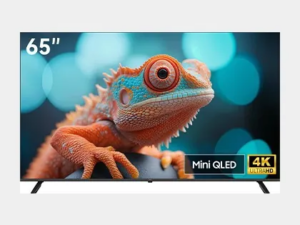
At NPC, we apply this product-layer approach to our smart TV portfolio. Our NPC Mini LED 65M1 combines a 65-inch format with QD-MiniLED display technology and Samsung TizenOS TV. Its listed resolution is 3840 × 2160, supporting a 4K UHD viewing experience, while the specification identifies NT72690 as its chassis.
The model also lists Digital TV as its digital TV/ATV configuration and supports HDR compatibility. Its product feature information includes Netflix, Prime Video, YouTube, and ThinQ AI. For buyers evaluating wholesale televisions, this combination shows how display technology, operating system, content services, and resolution can work together in one product.
Building a More Informed TV Portfolio
For distributors and retailers, product mix should reflect the market rather than a single technology label. Standard LED models can address mainstream price-sensitive demand, while QLED and Mini LED configurations can serve customers looking for enhanced color, brightness, contrast, or HDR performance. Smart TV platforms add differentiation through software and connected services.
At NPC, we are a technology manufacturing enterprise specializing in smart TVs, monitors, and computing products. We develop TV series around licensed platforms such as Samsung TizenOS, LG webOS Hub, and Whale TV, helping our partners address different market requirements. Whale TV describes its platform as a licensable TV operating system for brands, with personalized content discovery and smart TV functions.
Selecting the Right Combination for Your Market
Understanding the terminology makes television procurement more structured. LED establishes the LCD-backlit foundation; QLED adds Quantum Dot technology; Mini LED refines backlight control; and Smart TV connects the hardware with an operating system and digital content ecosystem. For business purchasing teams, comparing these layers alongside specifications and commercial requirements can make portfolio planning more precise.
At NPC, we aim to bring cost-effective TV products to users worldwide while maintaining strict quality standards and integrating authorized technologies from outstanding TV operating system providers. If you are planning a new TV portfolio or sourcing wholesale televisions for your market, contact NPC to discuss suitable models and product configurations.