

Spec-sheet numbers often mislead hardware buyers. A laptop boasting peak clock speeds can throttle performance rapidly if internal heat cannot escape the chassis. Pairing a vivid screen with an undersized battery leaves mobile workers tethered to wall outlets during work shifts.
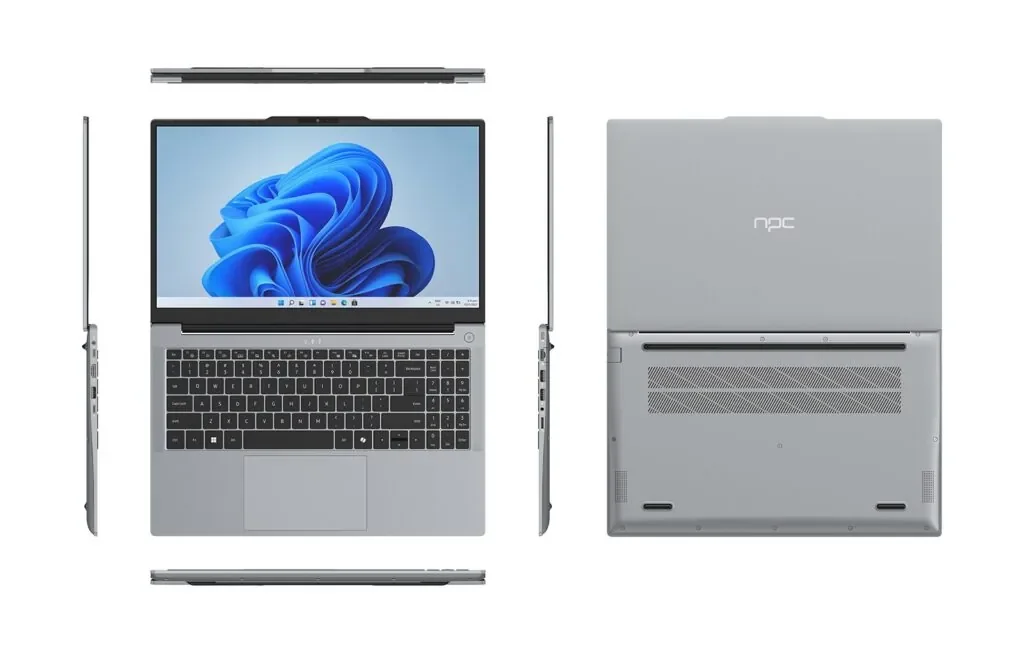
True mobile capability requires five core engineering pillars to operate in harmony: processing power, display optics, battery stamina, thermal management, and physical construction. Evaluating how these systems interact prevents costly procurement mistakes and ensures consistent workflow execution.
Processor Architectures and Memory Throughput
Processor architectures govern how software instructions translate into daily output. Intel Core platforms, spanning i3-1215U to i5-1235U, i7, and Core Ultra tiers, supply high single-thread clock frequencies suited for administrative data entry and rapid spreadsheet updates. Integrated Intel Iris Xe graphics render visual presentations cleanly without taxing central execution cores.
Complex multitasking and heavy software compilation favor AMD Ryzen platforms such as Ryzen 5 5500U, Ryzen 5 7430U, and Ryzen 7 7730U. These processors divide heavy processing jobs across multi-core pipelines, keeping system execution steady under continuous loads. Integrated AMD Radeon graphics deliver smooth video playback across multi-window business applications.
System memory serves as the immediate buffer for active programs. Equipping hardware with 16 GB of DDR4 memory running at 3200MHz sustains fluid transitions across concurrent web portals and enterprise databases. Upgrading to DDR5 architectures reaching 5600MHz expands data transfer bandwidth significantly, allowing processors to pull large files in fewer clock cycles.
Motherboards featuring dual SO-DIMM sockets extend machine longevity. Users can scale memory up to 64 GB as software requirements grow over multi-year deployments. Solid-state M.2 2280 PCIe storage from 128 GB to 1TB ensures rapid Windows 11 boot sequences, while built-in TF card slots provide convenient secondary data paths for quick file backups.
Display Dimensions, Aspect Ratios, and Optical Clarity
Screen dimensions dictate the balance between carrying convenience and functional desk workspace. Compact 14-inch laptops weighing roughly 1.4 kg support agile business travel. Meanwhile, larger 15.6-inch, 16-inch, and 17.3-inch panels provide expansive desktop surfaces for detailed visual reviews, financial audits, and multi-column data tables.
Panel aspect ratios influence daily reading efficiency. Traditional 16:9 displays with 1920 by 1080 Full HD resolution render video and standard office slides cleanly. Modern 16-inch displays with 16:10 aspect ratios expand vertical workspace in 1920 by 1200 FHD or 2560 by 1600 QHD resolutions, reducing document scrolling during intensive text entry.
Viewing comfort hinges on underlying panel chemistry. In-Plane Switching screens maintain sharp contrast and consistent colors across wide angles. Off-center viewers inspect charts and spreadsheets without chromatic fading or contrast distortion, preventing eye strain during extended work sessions.
Battery Chemistry and Regulated Power Management
Unplugged productivity depends entirely on reliable electrical storage. Deploying 7.6V/45.6Wh or 11.4V/55Wh lithium-ion polymer battery cells provides six to eight hours of active field operation. Mobile professionals complete workdays, off-site meetings, and travel commutes without searching for charging outlets.
Stable charging circuitry preserves chemical battery health across extended ownership cycles. Dedicated DCIN power ports route regulated voltage from factory-matched adapters directly to internal power management chips. Avoiding uncertified charging accessories shields delicate battery cells from voltage spikes, maintaining consistent runtime capacity over years of daily cycling.
Thermal Dissipation and Environmental Tolerances
Internal heat dissipation governs whether silicon maintains its advertised speed. Processors engineered with a thermal design power between 15W and 35W generate modest thermal loads. Low heat output allows cooling fans to run quietly during daily tasks, avoiding distracting fan noise in quiet offices.
Preserving internal hardware requires respecting ambient operating boundaries. Devices run reliably within ambient temperatures of 0 ℃ to 40 ℃. Maintaining relative humidity levels between 20% and 80% prevents moisture buildup near delicate soldered components. Controlled operating environments safeguard motherboards against sudden thermal throttling during heavy computational spikes.
Chassis Engineering, Ergonomics, and Port Utility
Procurement managers evaluating the best laptop manufacturers examine structural chassis engineering closely. Blending aluminum metal alloys with reinforced plastics produces a sturdy enclosure measuring between 18.05mm and 19.0mm in thickness. Rigid exterior housing shields internal circuitry from drops and daily travel stresses.
Input hardware shapes daily working comfort. Backlit keycaps prevent typos in dark meeting spaces, while physical webcam privacy covers block camera sensors mechanically. Integrated stereo speakers reproduce vocal audio clearly during remote video conferences without requiring external desktop speakers.
Native interface selection eliminates cumbersome external adapters. Chassis layouts incorporating Type-C, USB 3.2 Gen 1, and USB 2.0 ports connect diverse peripherals simultaneously. Built-in HDMI ports output video to conference projectors, while RJ45 Ethernet jacks secure stable wired networking alongside a 3.5mm audio port for private headsets.
Balancing Hardware Systems for Long-Term Value
Sourcing hardware through the best laptop manufacturers requires verifying that every internal sub-system balances correctly. Omitting expansion slots or shrinking battery capacity to hit a lower price tag ultimately harms user efficiency. Balanced hardware design yields equipment that stands up to sustained commercial use across changing business environments.
Our production lines at NPC combine Intel Core and AMD Ryzen mobile platforms with durable IPS panels across 14-inch to 17.3-inch form factors. Since our founding in 2005, we have expanded our manufacturing footprint to serve commercial partners across more than 80 countries.
Every unit built by NPC includes a 2-year warranty protecting the entire machine and core modules—including motherboards, processors, memory, screens, drives, and batteries—under normal operating conditions.
Technical assistance is accessible via our website, customer hotline, and authorized service centers. Submit your project requirements to NPC to discuss custom configurations, evaluate sample units, or secure direct factory pricing for your upcoming commercial deployment.