

Evaluating television hardware often leaves buyers sorting through confusing marketing acronyms. While self-emissive organic displays struggle with peak brightness in sunlit spaces and conventional edge-lit screens wash out dark cinematic scenes, miniature diode arrays offer a balanced alternative. Determining the best mini LED TV requires examining the core physical architecture that governs illumination, color purity, and frame pacing.
When thousands of microscopic diodes replace broad backlighting zones, optical precision improves noticeably. Distinguishing between genuine visual advancements and exaggerated claims comes down to evaluating five verifiable hardware disciplines.
Backlight Micro-Structures and Contrast Control
Direct illumination architecture dictates how cleanly a screen handles extreme contrast swings. Conventional direct LED panels group broad lighting clusters together, creating visible halo effects around subtitles or bright objects against space backgrounds. Mini LED backlights overcome this limitation by deploying dense fields of miniature light-emitting diodes situated directly behind the liquid crystal layer.
Dividing these miniature diodes into discrete local dimming zones allows the timing controller to throttle illumination on a granular level. Deep shadows receive minimal to no illumination, preserving true black levels. Simultaneously, adjacent specular highlights receive focused electrical current to produce striking peaks.
This localized light regulation directly addresses light blooming. Keeping optical energy confined to designated zones produces crisp boundaries between light and dark picture elements. Viewers observe clean contrast lines across widescreen movies and moody video scenes without distracting light wash.
Quantum Dot Light Conversion and Color Volume
Luminance control alone cannot reproduce realistic imagery without an accurate chromatic foundation. A miniature diode array provides concentrated white or blue illumination, but it lacks the chemical properties needed to generate rich color tones independently. Advanced displays solve this by positioning a Quantum Dot optical layer across the light path.
Quantum dots are microscopic semiconductor crystals that react to high-energy backlight photons. When stimulated, they convert the underlying illumination into exceptionally pure green and red wavelengths. This optical conversion yields a uniform spectral balance, delivering wide color gamut coverage exceeding 85% NTSC.
Identifying the best mini LED TV requires verifying both diode density and this quantum dot conversion layer. Operating without QD filtration limits saturation at higher brightness settings. Designated QD-MiniLED, this pairing keeps colors vivid across daylight viewing and darkened home cinema rooms alike.
Resolution Matrices, Screen Sizing, and Spatial Ergonomics
Visual clarity depends upon pairing backlight precision with a dense physical pixel grid. Contemporary Mini LED displays utilize 4K Ultra High Definition panels featuring 3840 by 2160 active pixels. This arrangement provides four times the detail of legacy Full HD panels, rendering text contours and architectural textures with remarkable precision.
Panel size selections primarily center around 55-inch and 65-inch formats. Selecting the correct screen dimension requires matching physical hardware against room layout to preserve optical comfort. Room depth dictates how comfortably a viewer resolves fine detail without ocular fatigue.
Standard spatial formulas provide clear positioning baselines for shared spaces. An immersive 1.5-coefficient viewing distance allows dedicated media viewers to engage deeply with 4K content. For casual broadcasts, a relaxed 2.5-coefficient guideline creates comfortable sightlines that prevent visual strain during marathon watching.
Frame Synchronization and Motion Frequencies
Image fluidity relies on how rapidly the display refreshes its visual buffer. Refresh rates define how many unique frames appear on screen each second. Baseline panels operate at 60 Hz, updating sixty times per second to provide stable playback for conventional broadcast programs, daily news channels, and streaming episodic content.
Different media types operate under distinct frame rates. Cinema releases capture scenes at 24 frames per second, while television broadcasts transmit at 30 frames per second. Sports broadcasts and modern games push frame production to 60 frames per second. Matching source frames with native panel refresh rates prevents frame judder and blurring.
Competitive video gaming environments demand elevated refresh capabilities. Selecting panels supporting 120 Hz or 144 Hz refresh speeds accommodates rapid frame outputs from gaming consoles and performance computers. High-frequency screen cycling eliminates ghosting trails during fast camera pans, delivering sharp visual tracking in fast-paced action sequences.
Smart Platform Architecture and Home Connectivity
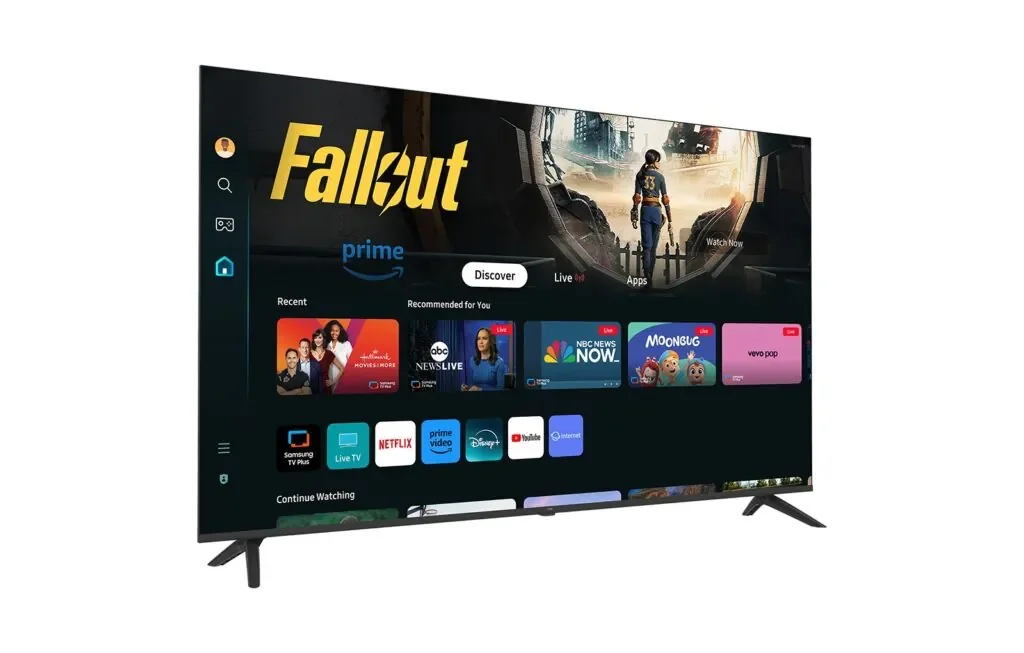
Operating software dictates everyday usability across modern connected displays. Deploying licensed operating platforms, such as Samsung Tizen OS powered by the NT72690 chipset, ensures stable execution across native streaming portals. Viewers access essential services including Netflix, Prime Video, and YouTube without sluggish menu buffering.
Connected ecosystems extend display utility into wider residential automation. Integrated voice interfaces like Bixby allow users to search titles or modify sound profiles through spoken vocal cues. Via SmartThings, screens connect seamlessly with Apple HomeKit, Google Home, and Matter-compatible hardware to coordinate home peripherals.
Firmware maintenance safeguards long-term performance. The platform uses over-the-air (OTA) update delivery to download and install software patches directly over active internet connections. Regular updates resolve compatibility bugs and protect system navigation as streaming applications update their requirements over time.
Technical Procurement and Factory Production Standards
Separating genuine hardware capability from promotional hype requires prioritizing verifiable specifications: local dimming density, quantum dot filtration, 4K matrix precision, and native refresh speeds. Aligning these parameters prevents unexpected picture degradation and secures lasting hardware utility across residential or hospitality environments.
Within our production facilities at NPC, we engineer certified 55-inch and 65-inch QD-MiniLED displays built upon licensed Tizen OS architecture and NT72690 processing chipsets. Our factory operations combine high-density local dimming backlights with optical testing to deliver reliable visual solutions to global distributors.
A full three-year guarantee covering the whole machine under normal working circumstances is included with every display that NPC makes. Our authorised regional service stations, specialised telephone hotlines, and official online site are still available for technical help and customer support.
Share your technical deployment requirements with NPC to request comprehensive specification sheets, review production samples, or receive a customized wholesale quotation.