

Corporate procurement teams often equate high performance with gaming-tier hardware, assuming that maximum clock speeds solve every enterprise bottleneck. Yet high-powered graphics and noisy cooling fans provide zero benefit during financial audits, virtual client presentations, or airport layovers. Excessive heat and rapid battery drain disrupt daily business operations instead of supporting them.
Real business productivity requires sustained reliability rather than temporary performance spikes. Corporate users require balanced hardware that runs spreadsheet macros smoothly, transitions seamlessly between cloud services, and operates quietly in boardroom meetings. Identifying what business users genuinely need prevents procurement missteps and protects IT investments.
Processing Stability and Computational Responsiveness
Modern office workloads involve data analysis, database administration, and video meetings. Deploying a high performance business laptop means matching silicon architectures to these specific workflows.
Intel Core platforms, spanning i3-1215U, i5-1235U, i7, and Core Ultra options, deliver fast single-thread performance. These chips handle administrative database navigation and document processing crisply.
Multi-threaded operations benefit from AMD Ryzen processors, including Ryzen 5 5500U, Ryzen 5 7430U, and Ryzen 7 7730U. Parallel multi-core execution allows employees to compile large reports while running conference calls and cloud backups simultaneously. Integrated graphics, such as Intel Iris Xe and AMD Radeon, drive external displays smoothly without drawing excessive power.
Memory Bandwidth and Modular Storage Scalability
Dynamic random access memory serves as the vital workspace for active business programs. Equipping systems with 16 GB of DDR4 memory running at 3200MHz maintains responsive application switching across dozens of browser tabs and dense data tables. Demanding enterprise tasks leverage high-speed DDR5 memory operating up to 5600MHz, accelerating memory transfers across system buses.
Expanding system memory via dual SO-DIMM sockets extends hardware usability over multi-year deployment cycles. Organizations can upgrade memory capacity up to 64 GB as enterprise software grows more demanding. Modular sockets protect companies from premature fleet retirements caused by non-upgradable soldered memory.
Fast solid-state storage completes the computational pipeline. Deploying M.2 2280 PCIe solid-state drives across 128 GB, 256 GB, 512 GB, and 1TB capacities supports swift Windows 11 boot cycles and prompt file access. Built-in TF card slots offer convenient local channels for quick file transfers and data backups without utilizing primary system drives.
Ergonomic Screen Geometry and Panel Optics
Visual ergonomics dictate how effectively users digest information across prolonged work shifts. Display sizes spanning 14.1-inch, 15.6-inch, 16-inch, and 17.3-inch panels suit different mobility requirements. Compact 14.1-inch models weighing roughly 1.4kg serve mobile travelers, while 15.6-inch and 17.3-inch displays provide expansive desktop viewing for office desks.
Adopting a 16:10 aspect ratio delivers measurable productivity advantages over traditional 16:9 widescreen formats. Available in 1920 by 1200 FHD or 2560 by 1600 QHD resolutions, 16-inch displays expand vertical screen space. Extra vertical pixels display additional document lines and spreadsheet rows, cutting down manual scrolling during document reviews.
Wide-angle In-Plane Switching panels preserve color fidelity and contrast across broad viewing angles. Colleagues reviewing financial models or presentation decks from off-axis angles observe consistent images without washed-out colors. Clear text rendering helps alleviate ocular fatigue during long typing sessions.
Power Management and Quiet Thermal Dissipation
Mobile professionals require dependable power away from electrical outlets. Equipping laptops with 7.6V/45.6Wh or 11.4V/55Wh lithium-ion polymer battery packs delivers six to eight hours of typical runtime. Balanced power draw allows mobile staff to complete travel days without hunting for power sockets.
Regulated electrical delivery through factory DCIN adapters preserves internal battery cell chemistry. Operating with certified power supplies prevents voltage spikes that degrade battery charge retention over repeated charging cycles. Steady power flow maintains predictable battery runtimes across corporate deployments.
Quiet thermal dissipation remains equally vital in collaborative workspaces. Mobile processors engineered with thermal design power ratings between 15W and 35W produce moderate heat.
Low thermal output keeps cooling fans quiet during video calls. Maintaining ambient operating temperatures between 0 ℃ and 40 ℃, alongside 20% to 80% humidity, protects internal circuitry from heat stress.
Physical Security, Native Ports, and Transit Durability
Hardware-level privacy features safeguard confidential communications inside modern office spaces. Built-in webcams equipped with physical privacy switches allow users to cover lenses mechanically, providing verified security beyond software toggles. Backlit keyboards allow error-free typing in dimly lit flight cabins and meeting halls.
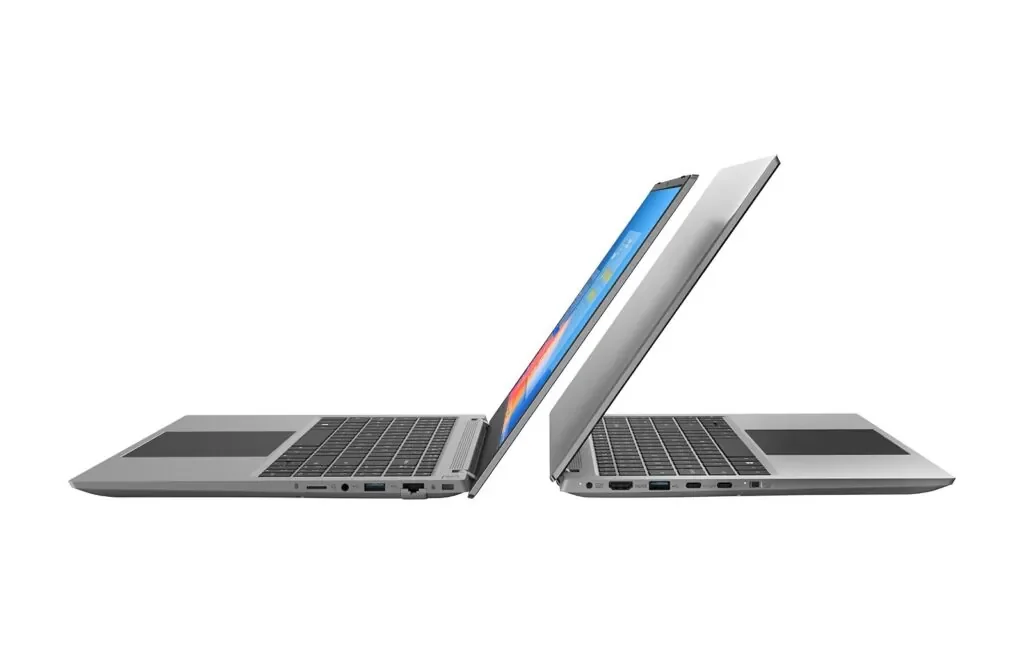
Avoiding external adapters requires native interface variety across the chassis. Enclosures incorporating Type-C, USB 3.2 Gen 1, and USB 2.0 ports connect office peripherals simultaneously.
Built-in HDMI outputs link conference projectors, while integrated RJ45 Ethernet jacks provide stable wired networking when office Wi-Fi networks experience congestion.
Field mobility requires rugged structural engineering. Combining aluminum alloy surfaces with durable structural plastics produces an enclosure measuring 18.05mm to 19.0mm in thickness. Rigid exterior housing shields internal motherboards from daily transit vibrations while preserving manageable carrying weight.
Enterprise Procurement and Factory Support Standards
Balancing these technical dimensions helps a high performance business laptop satisfy real workplace demands rather than superficial marketing benchmarks. Corporate users need responsive multi-core processors, expandable memory sockets, ergonomic displays, quiet thermal management, and reliable battery runtimes. Focusing on functional synergy delivers lasting equipment utility across commercial deployments.
Across our manufacturing lines at NPC, we assemble enterprise laptops combining Intel Core and AMD Ryzen mobile platforms with tested IPS displays from 14.1 to 17.3 inches. Operating since 2005, our factory facilities supply durable business laptops to commercial clients across more than 80 countries.
Deploying systems from NPC provides enterprise teams with a 2-year warranty covering the complete machine and major components—including motherboards, processors, memory, screens, storage, and batteries—under normal operating conditions. Technical assistance is accessible via our official website, customer service hotline, and authorized service centers.
Submit your corporate hardware requirements to NPC today to review complete specification sheets, discuss custom volume configurations, and secure direct factory pricing for your business fleet.