

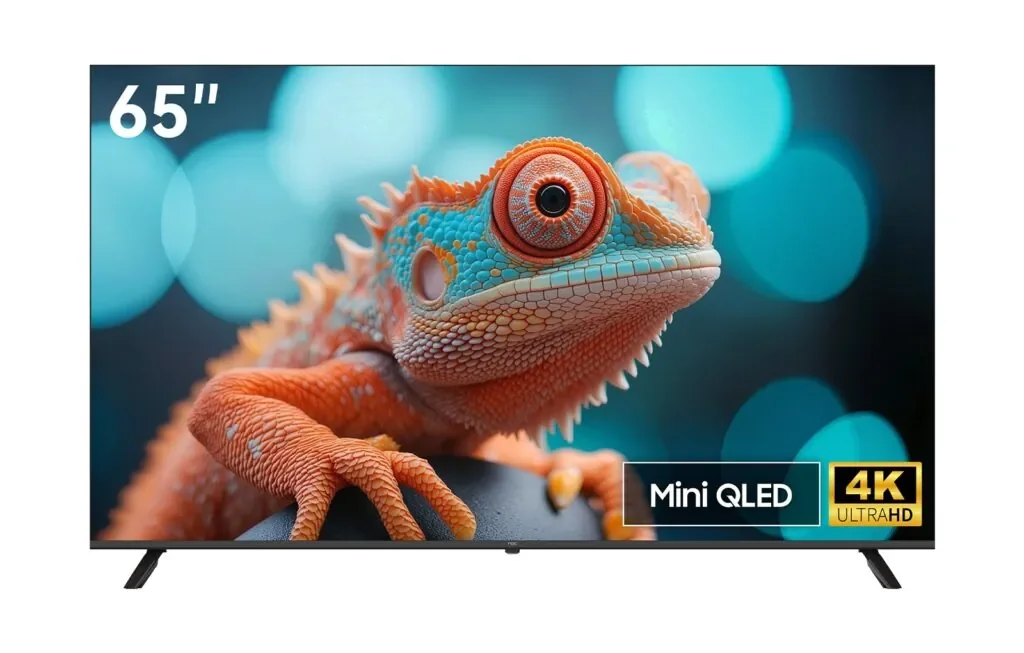
Choosing a living room screen involves calculating how physical panel dimensions align with room geometry and human visual limits. A 55-inch display represents the most versatile dimensional threshold in modern homes, balancing expansive viewing immersion with manageable footprint requirements. Combining this intermediate physical format with dense Mini LED backlighting unlocks high-end dynamic range without demanding massive wall space.
Physical Dimensions and Spatial Field of View
Display dimensions follow an industry-standard 16:9 widescreen aspect ratio. Measured diagonally across active glass, a 55-inch screen measures exactly 139.7 centimeters from corner to corner. This translates to a horizontal width of approximately 121.8 centimeters and a vertical height of roughly 68.5 centimeters, excluding exterior cabinet bezels or tabletop mounting feet.
Spatial proportions make this footprint compatible with both compact apartments and medium-sized lounges. Covering roughly 0.83 square meters of visual territory, the screen occupies sufficient optical space to engage central vision without overwhelming peripheral lines of sight. Interior arrangements accommodate this profile effortlessly on standard media consoles measuring 140 centimeters or via universal VESA wall brackets.
Field of view calculations determine psychological engagement during movie playback or interactive entertainment. Cinema standards target an optical field between thirty and forty degrees to create a theater-like sensation. Standard broadcast programming requires slightly less visual coverage, ensuring viewers track fast-moving sports action or news tickers without continuous lateral head movement.
Calculating Viewing Distance Against 4K Human Visual Acuity
Human eye resolution governs the ideal physical distance between seating positions and the glass surface. Healthy vision resolves approximately one arcminute of detail, meaning individual pixels blend into seamless imagery when viewed from a specific threshold. Sitting excessively far dissolves fine texture rendering, whereas sitting too close exposes individual raster points.
Ultra High Definition delivers 3840 horizontal pixels by 2160 vertical pixels across the matrix, totaling over 8.29 million distinct addressable points. On a 55-inch panel, this density translates to roughly 80 pixels per inch. At this concentration, the human eye cannot discern individual pixel structures once viewing distance exceeds 1.1 meters.
Placing a 55 inch mini LED TV inside a standard residential space typically establishes an optimal seating range between 1.5 and 2.2 meters. Seating positioned around 1.7 meters creates an immersive 40-degree field of view for high-resolution cinematic media. Moving back toward 2.2 meters accommodates casual, long-term viewing of linear television broadcasts while preventing optical fatigue.
Backlight Architecture: Mini LED Diodes, Local Dimming Zones, and Pixels
Backlight engineering defines how effectively liquid crystal panels manage contrast and black levels. Conventional LED televisions utilize a modest cluster of edge-lit or direct-lit diodes that illuminate large areas of the screen simultaneously. Mini LED technology downsizes individual emitter chips to miniature dimensions, packing thousands of diodes directly behind the active LCD matrix.
Precision light control relies on grouping these physical emitters into independent local dimming zones. An LED serves as an individual light-emitting component, whereas a zone constitutes a cluster of diodes governed synchronously by processor algorithms. Denser zone configurations allow the display to turn off illumination behind dark scenes while driving adjacent bright highlights.
Distinguishing backlight zones from LCD pixels prevents common technical confusion. While dimming zones manage regional illumination behind the panel, the 8.29 million LCD pixels modulate color and fine image details in front. Segmenting backlight zones minimizes halo effects, keeping bright white subtitles crisp against deep black space backgrounds without disturbing surrounding darkness.
Peak Luminance, Ambient Room Reflection, and HDR Performance
Sunlit environments present major challenges for standard display backlights. Ambient daylight washing through windows reflects off glass substrates, flattening dark gradients and washing out vibrant tones. Mini LED backlights overcome ambient glare by producing sustained luminance levels that outperform conventional edge-lit televisions.
Integrating quantum dot optical films enhances chromatic purity across bright scenes. Quantum nanocrystals convert narrow-spectrum blue light from Mini LEDs into rich red and green wavelengths before reaching the liquid crystal layer. This optical stack enables panels to achieve wide color gamuts exceeding 85% NTSC, preserving saturation even at elevated output levels.
Deploying a 55 inch mini LED TV in illuminated spaces delivers dynamic range that standard LCDs cannot match. High Dynamic Range formats demand instantaneous luminance peaks to render specular reflections like polished chrome or direct sunlight realistically. Generating high peak brightness alongside controlled local dimming delivers exceptional perceived contrast across diverse viewing conditions.
High-Precision Display Engineering from NPC
At NPC, our advanced manufacturing centers engineer commercial and consumer displays built for demanding international markets. Our 55-inch QD-MiniLED flagship, the NPC-MiniLED 55M1, combines 4K UHD resolution, 140 precision local dimming zones, and peak brightness exceeding 800 cd/m².
Driven by the Novatek NT72690 chipset and equipped with the officially authorized Samsung Tizen OS platform, our displays deliver fluid streaming performance, extensive smart home connectivity, and a standard three-year whole-machine warranty. Discuss your target regional distribution requirements or request detailed hardware evaluation samples by connecting with our technical sales division at NPC today.