






For competitive gamers and immersive enthusiasts alike, display technology has become the ultimate determinant of performance and visual fidelity. The market currently pits OLED (Organic Light-Emitting Diode) against the highest-end Mini-LED LCDs, but the conversation is increasingly turning to the theoretical heir apparent: MicroLED. This next-generation tech promises to deliver the benefits of OLED without its few crucial drawbacks, but its journey from the laboratory to the desktop remains fraught with complex manufacturing hurdles.
The question for gamers planning to buy gaming monitor today is whether MicroLED is an imminent replacement for OLED, or merely a distant future promise. The answer lies in the fundamental chemistry and the current engineering challenges of these cutting-edge displays.
The Technical Leap: How MicroLED Works
MicroLED is the display technology that could truly define the next decade of visual computing. Like OLED, MicroLED is self-emissive, meaning each individual pixel generates its own light and color, allowing it to turn off completely to achieve perfect black levels and an infinite contrast ratio.
The critical distinction is the material:
l OLED uses organic light-emitting compounds, which provide flexibility and incredible image quality but are susceptible to degradation, burn-in (permanent image retention from static elements like HUDs or health bars), and have limitations on peak brightness.
l MicroLED uses inorganic microscopic LEDs (typically smaller than 50 µm) for each subpixel. This switch to inorganic material retains the self-emissive advantages of OLED while solving its core weaknesses.
This inorganic nature makes MicroLED inherently more stable, durable, and capable of extreme light output, creating a display with theoretically superior performance across all key metrics vital to an optimal gaming experience.
MicroLED vs. OLED: The Gaming Showdown
In the high-stakes world of competitive gaming, two features matter most: response time and contrast. OLED currently excels in response time, but MicroLED promises to deliver the speed advantage while eliminating the durability risk.
Feature | OLED (Current Consumer Leader) | MicroLED (Future Technology) | Gaming Relevance |
Contrast | Infinite (True Black) | Infinite (True Black) | Eliminates "haze" in dark scenes for maximum visibility. |
Response Time | Extremely Fast (0.1–0.3 ms) | Sub-Nanosecond (Theoretically fastest possible) | Eliminates motion blur, ghosting, and input lag. |
Peak Brightness | Moderate (Limit due to organic material) | Extremely High (Up to 5,000+ Nits) | Crucial for stunning HDR gaming visuals and visibility in bright rooms. |
Burn-In Risk | Vulnerable (Due to organic degradation) | Minimal/None (Inorganic material) | Ensures durability when displaying static elements (HUDs, taskbars) for hours. |
Cost & Availability | Moderate/High (Widely available) | Extremely High (Limited to niche/commercial use) | The biggest hurdle for consumer adoption. |
The technical takeaway for gamers is clear: MicroLED has the potential to be the ultimate display technology, combining the perfect blacks of OLED with the extreme brightness and durability of traditional inorganic displays.
The Reality Check: Why MicroLED Isn't on Your Desk Yet
If MicroLED is so superior, why isn't it available to gamers today? The answer is purely one of manufacturing complexity and cost.
The fabrication of a small, consumer-sized gaming monitor requires the precise placement (a process called mass transfer) of tens of millions of microscopic, single-color LEDs onto a backplane with near-zero defects. Achieving this level of precision and yield at a small scale is proving to be immensely difficult and incredibly expensive.
Current estimates suggest the cost of producing a MicroLED monitor must fall by a factor of 20 or more to compete with the price points of established OLED and Mini-LED technologies. As a result, MicroLED is currently limited to two main market segments:
1. Massive Commercial Displays: Tiled, modular video walls (where the high cost is justified for large installations).
2. Niche Microdisplays: Tiny, ultra-bright displays for AR/VR headsets (where MicroLED's extreme brightness is essential to compete with outdoor sunlight).
For the consumer desktop market, industry experts believe mainstream adoption of MicroLED for monitors is still several years away, likely arriving in the late 2020s at the earliest. Until the production challenges (especially the notorious "mass transfer" and "red LED efficiency" problems) are solved, OLED and Mini-LED will continue to dominate the premium display space.
The Present Solution: High-Performance Gaming Monitors
Since MicroLED remains a technology of the future, the current best options for a gamer looking to buy gaming monitor lie in proven, commercially mature technologies that offer high speed and visual quality today: OLED and high-end Fast IPS/VA panels, often enhanced with Mini-LED backlighting.
This is where NPC excels, providing high-speed, cost-effective solutions engineered for modern competitive gaming workflows.
NPC is a technology manufacturing company established in Guangzhou, China, in 2005. Its core business is high-definition display products, specializing in providing high-quality and affordable video display products and IT computer products for the global market. NPC’s mission is to combine innovation with reliability and cost-effectiveness.
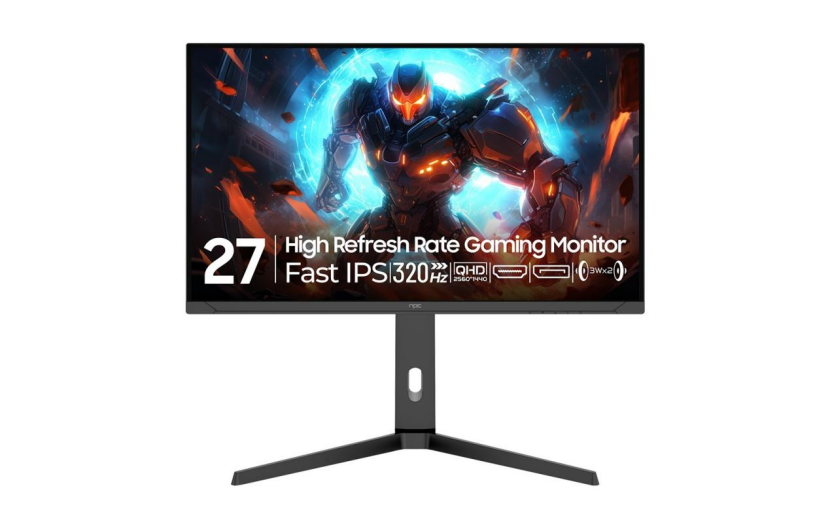
The NPC gaming monitor line is designed specifically to deliver the speed and visual quality that gamers demand today. For those seeking a competitive edge, NPC offers:
NPC Gaming Monitor Feature | Technical Specification | Competitive Advantage |
Refresh Rate | Up to 520 Hz (on select FHD models) | Unparalleled motion clarity and frame latency for esports. |
Response Time | As low as 1 ms | Virtually eliminates ghosting and motion blur. |
Panel Types | Fast IPS, VA Curved, Ultra-wide | Versatile range from competitive speed (IPS) to immersive quality (VA/Curved). |
Adaptive Sync | FreeSync/G-Sync Compatible | Synchronizes display with GPU output to eliminate screen tearing. |
Resolution | Full HD (FHD) to Ultra HD (UHD) | Options for competitive speed or high-fidelity visual immersion. |
By focusing on optimized response times, ultra-high refresh rates, and a wide array of form factors (including ultra-wide and curved designs up to 49 inches), NPC gaming monitors provide the reliable performance needed to dominate any digital battlefield, ensuring that gamers don't have to wait for the distant promise of MicroLED to upgrade their setup.


